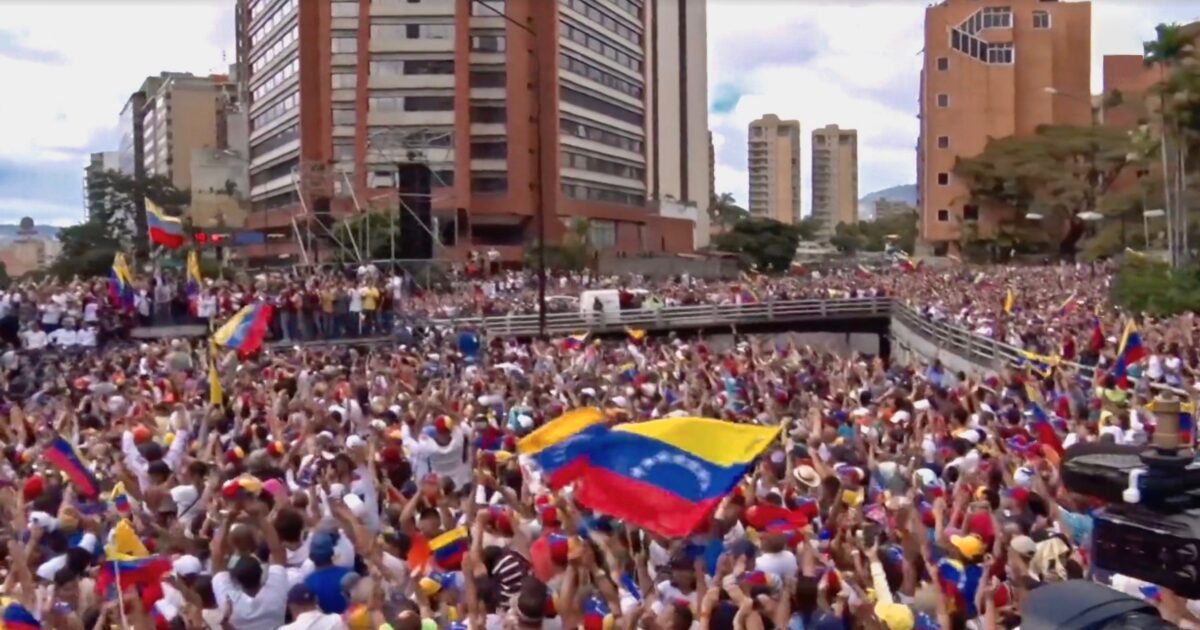
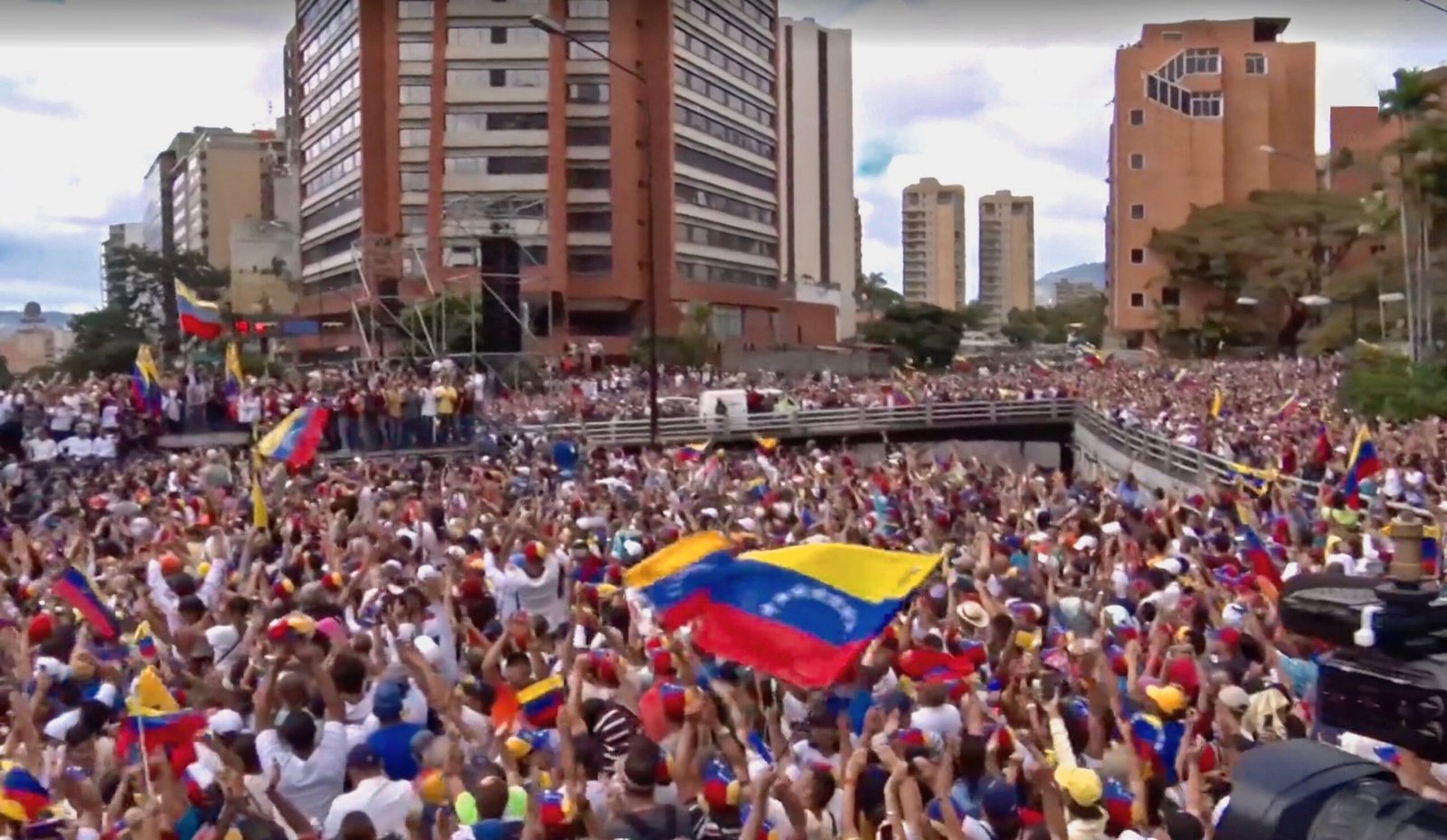
Street protests erupted in Caracas one month after Nicolás Maduro was captured by U.S. forces, as Venezuela entered a volatile transition under Acting President Delcy Rodríguez. Pro-government and anti-government factions held simultaneous demonstrations reflecting sharply different demands for the country’s future.
Supporters of the ruling United Socialist Party of Venezuela marched to demand Maduro’s return, while other demonstrators called for justice, accountability, and an end to state-sponsored abuses.
Immediately following Maduro’s capture, thousands of government supporters, often referred to as Chavistas, marched in Caracas to demand his release and reaffirm loyalty to the PSUV. Since then, pro-Maduro protests have continued but remain scattered and increasingly overshadowed by opposition celebrations inside the country and across the diaspora.
Polling by Meganálisis conducted in mid-January 2026 found that 90 percent of Venezuelans inside the country expressed gratitude or approval for Maduro’s removal, suggesting loyalist protests represent a narrow segment of the population.
Pro-government rallies have been organized by senior party figures, including PSUV Secretary General Diosdado Cabello and mobilization leader Nahum Fernández. Estimates suggest peak demonstrations, such as the February 3 march, drew roughly 10,000 to 30,000 participants, largely state employees and core party loyalists.
Protest leaders have publicly reaffirmed loyalty to Rodríguez, who assumed the presidency on January 5, framing their demonstrations as support for stability while insisting Maduro’s detention was unjust. Fernández said the movement would remain in the streets and pledged continued backing for the government “in any scenario.”
Opposition-aligned demonstrators focused on accountability for past abuses, calling for investigations into senior officials and reparations for victims of state violence. These protests coincided with symbolic celebrations following the closure of El Helicoide, a detention center long denounced by international observers as a site of torture.
Despite widespread relief at Maduro’s removal, many Venezuelans have avoided public celebrations out of fear of armed pro-government collectives or uncertainty surrounding the U.S. presence.
As of early February 2026, the durability of pro-government protests appears to depend largely on the military’s posture. Defense Minister Vladimir Padrino López has expressed support for Rodríguez while criticizing the U.S. raid as “disproportionate,” but he has stopped short of calling for a military response, underscoring the shifting balance of power shaping Venezuela’s post-Maduro transition.
At the request of Venezuela and Colombia, the UN Security Council held an emergency meeting on January 5, 2026. Venezuela submitted a formal letter condemning the “abduction” of its president and accusing the United States of violating the UN Charter. Maduro’s legal team, along with representatives of the de facto government in Caracas, has also signaled its intent to file complaints with the International Criminal Court alleging a “crime of aggression.”
Critics within the remnants of the regime and commentators outside the country have accused the Trump administration of intervening in order to seize Venezuela’s oil. The administration has rejected that claim, framing the operation instead as part of a long-term stabilization and industrial recovery effort. Central to this approach is a “clean slate” energy policy built around a multi-billion-dollar investment plan to modernize Venezuela’s deteriorated infrastructure.
Under Executive Order 14373, the United States has deployed American service firms to repair refineries and supply the diluents required to process Venezuela’s heavy crude. The stated goal is to restore refining capacity to pre-Maduro levels and enable Venezuela to function as a self-sufficient energy producer rather than a sanctioned state burdened by decaying assets.
The financial framework of the deal is built on a custodial revenue-sharing model designed to bypass corruption while providing immediate liquidity to the Venezuelan state. In the weeks following Maduro’s removal on January 3, 2026, the United States moved to stabilize the economy by unblocking approximately $3 billion in oil-related funds.
This was followed by the issuance of U.S. Treasury General License 46, authorizing established U.S. companies to resume transactions that direct payments into the Venezuelan Central Bank.
While the United States retains oversight through Foreign Government Deposit Funds to prevent diversion to Maduro loyalists, the money is being released for currency auctions aimed at slowing hyperinflation and funding essential public services.
The influx of dollars has already begun to ease the hyperinflation that defined the Maduro era, shifting public sentiment toward relief and cautious expectation. Most Venezuelans are focused less on ideology than on whether the transition will deliver reliable electricity and affordable food.
Claims of “imperialist theft” remain a niche position concentrated among PSUV leadership and armed collectivos. For these groups, U.S. control over the timing and flow of oil payments represents a loss of personal leverage over the national budget rather than a loss of national wealth. Despite participating in the revenue-sharing arrangement, the interim government under Acting President Delcy Rodríguez continues a careful diplomatic balancing act.
Venezuela’s UN mission has officially labeled U.S. management of oil revenues as “coercive,” even as the central bank actively uses the funds, a move analysts view as preserving the option to pursue future legal claims of aggression while the country begins its first meaningful economic recovery in more than a decade.
The post Dueling Protests in Venezuela: Pro-Maduro Rallies Driven by Old Regime Minority appeared first on The Gateway Pundit.
Source: The Gateway Pundit
TruthPuke LLC hereby clarifies that the editors, in numerous instances, are not accountable for the origination of news posts. Furthermore, the expression of opinions within exclusives authored by TruthPuke Editors does not automatically reflect the viewpoints or convictions held by TruthPuke Management.