A federal judge blocked enforcement of the Trump administration’s seven-day notice requirement on congressional inspections of ICE facilities, finding the policy likely violated federal oversight law, but the administration is preparing a multi-pronged legal response that involves funding arguments, executive security claims, and potential Supreme Court intervention.
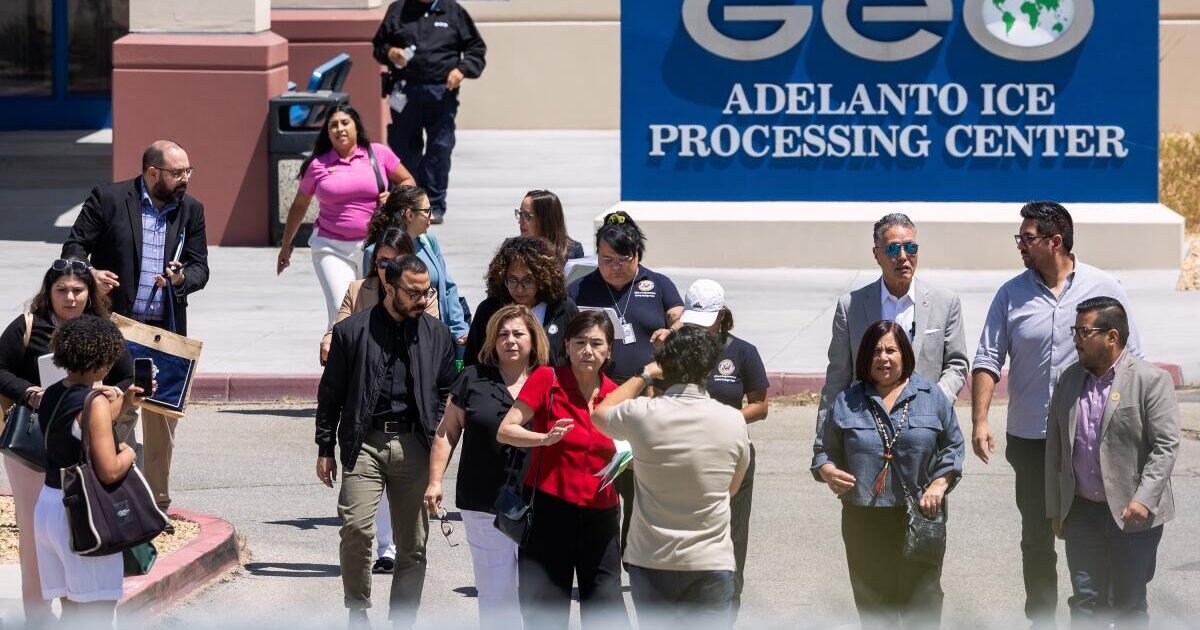
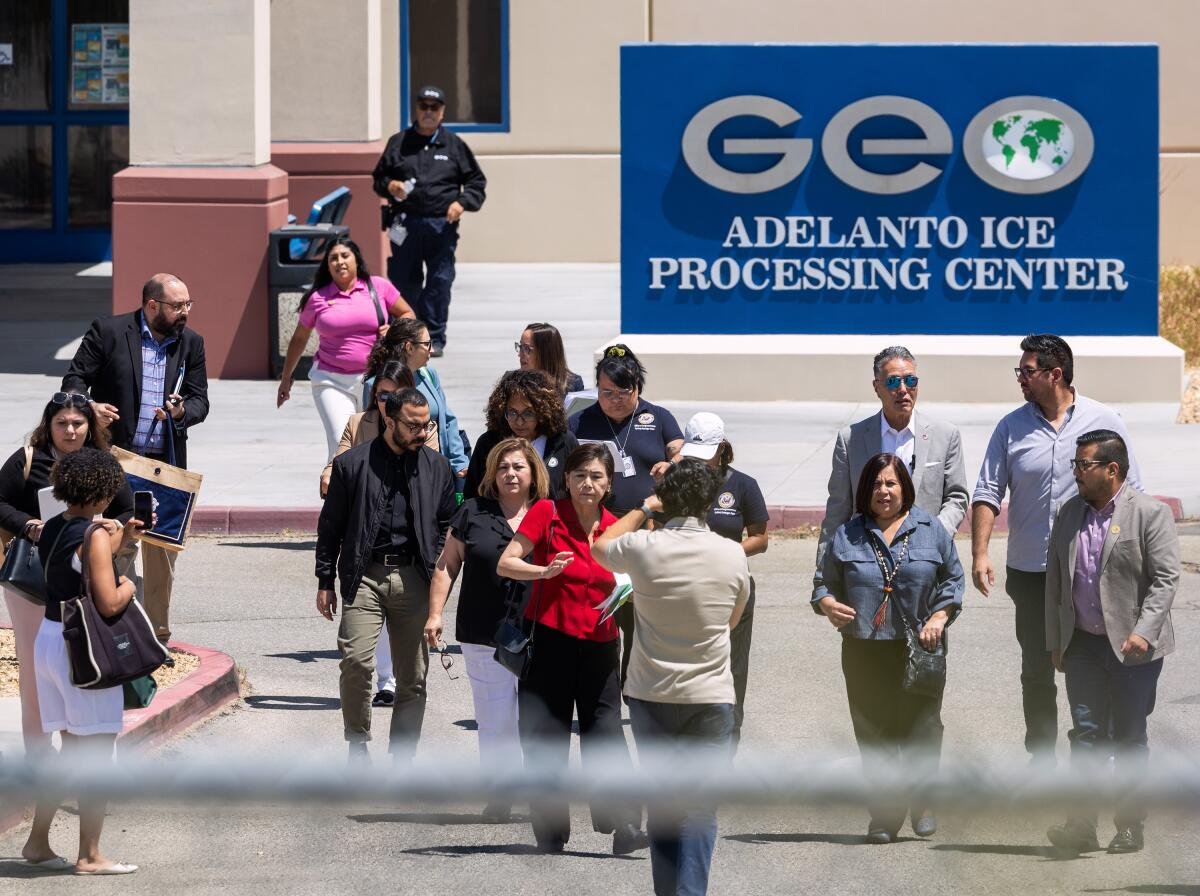
The dispute began in December 2025, when a federal court struck down the Department of Homeland Security’s requirement that lawmakers provide seven days’ advance notice before visiting ICE detention sites. The ruling reaffirmed statutory protections allowing Congress to conduct surprise inspections as part of its oversight authority.
DHS Secretary Kristi Noem reimposed the same notice requirement on January 8, 2026, arguing that certain ICE facilities were operating under funding from the One Big Beautiful Bill Act rather than traditional appropriations and were therefore exempt from standard oversight rules.
A memo issued that day instructed ICE to enforce the advance-notice policy using reconciliation bill funds, a move critics described as an effort to sidestep the earlier court order.
The reimposed policy was enforced on January 10, when Representatives Ilhan Omar, Angie Craig, and Kelly Morrison attempted to inspect the Bishop Henry Whipple Federal Building in Minneapolis. The lawmakers were initially allowed inside but were later asked to leave and denied a facility tour.
Oddly, Democratic lawmakers linked the shooting of Renee Good earlier that month to the need for more unannounced visits to detention centers, arguing that the incident required additional oversight to ensure detainees were treated humanely.
Members of Congress do have oversight authority over the executive branch, including ICE and DHS, but that authority does not equate to unrestricted access to secure law-enforcement environments. Even where unannounced visits are permitted, facilities may restrict access to sensitive areas, prohibit interference with ongoing operations, and delay or deny entry when immediate safety or security concerns exist.
A similar framework governs the federal prison system. While Congress has oversight authority over the Bureau of Prisons, unannounced inspections are conducted by the Department of Justice Inspector General under the Federal Prison Oversight Act of 2024, not by individual lawmakers. Congressional prison visits are typically coordinated in advance and granted as a matter of professional comity rather than statutory right.
These competing interpretations collided on February 2, 2026, when a federal judge in Washington, D.C., halted DHS’s seven-day notice policy. Judge Jia M. Cobb issued a temporary restraining order reinstating the right of members of Congress to conduct unannounced visits to ICE detention facilities.
The court ruled that the policy likely violates federal law, specifically Section 527 of the appropriations code, which prohibits the use of government funds to block congressional access to detention facilities. Judge Cobb rejected the administration’s argument that alternative funding streams under the One Big Beautiful Bill Act override statutory inspection rights and suggested that the January reimposition of the policy appeared to be an unlawful attempt to evade judicial oversight.
As of February 4, 2026, the ruling sharply limited DHS’s ability to restrict access through administrative policy changes. However, the decision was issued as a temporary restraining order, meaning it blocks the policy only briefly while the court considers whether to impose a preliminary injunction.
The administration is expected to appeal to the D.C. Circuit Court of Appeals, arguing that ICE facilities funded under the One Big Beautiful Bill Act are not subject to Section 527 restrictions contained in earlier appropriations laws. If that argument fails, the Department of Justice is likely to pivot to constitutional claims asserting presidential authority over national security and federal property, framing unannounced visits as operational hazards and political interference.
ICE has also attempted to reclassify certain sites, including the Whipple Building, as field offices or processing centers rather than detention facilities. Because Section 527 applies only to locations used to detain or house aliens, broader reclassification efforts could exempt additional sites from unannounced visit requirements.
With the Supreme Court’s conservative majority and its recent emphasis on the unitary executive theory, the administration may seek emergency relief if the D.C. Circuit does not rule quickly or favorably. By mid-February, Judge Cobb must decide whether to convert the temporary restraining order into a preliminary injunction, a move that would preserve congressional access for months while the case proceeds.
The post Trump’s Next Move in the Battle Over Unannounced Congressional Visits to ICE Detention appeared first on The Gateway Pundit.
Source: The Gateway Pundit
TruthPuke LLC hereby clarifies that the editors, in numerous instances, are not accountable for the origination of news posts. Furthermore, the expression of opinions within exclusives authored by TruthPuke Editors does not automatically reflect the viewpoints or convictions held by TruthPuke Management.