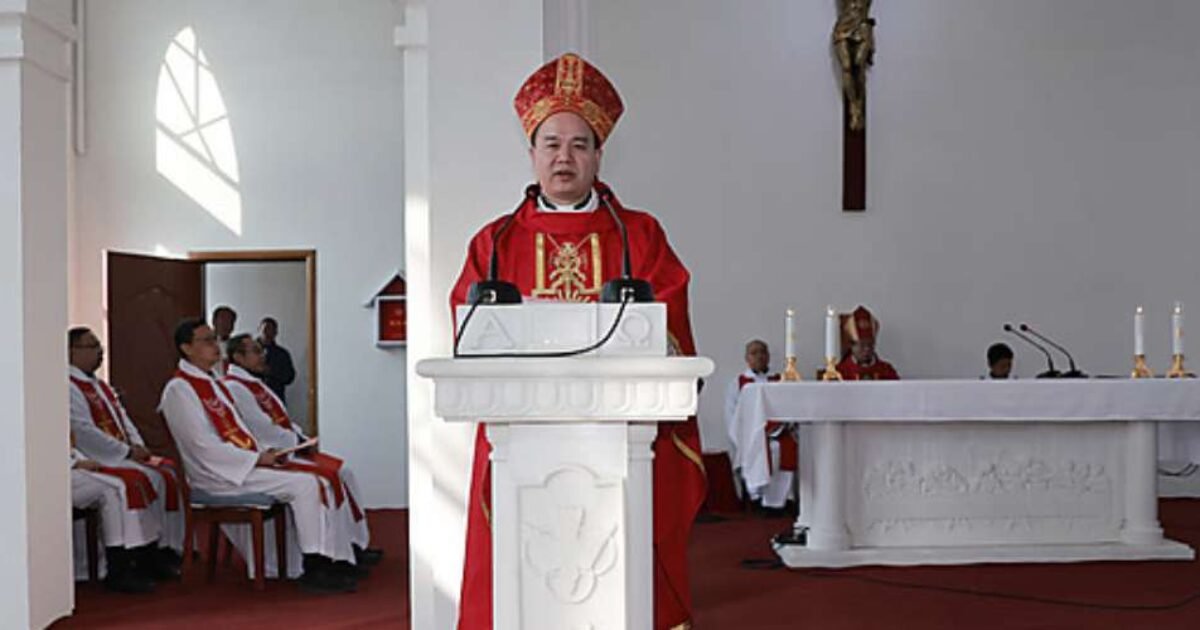
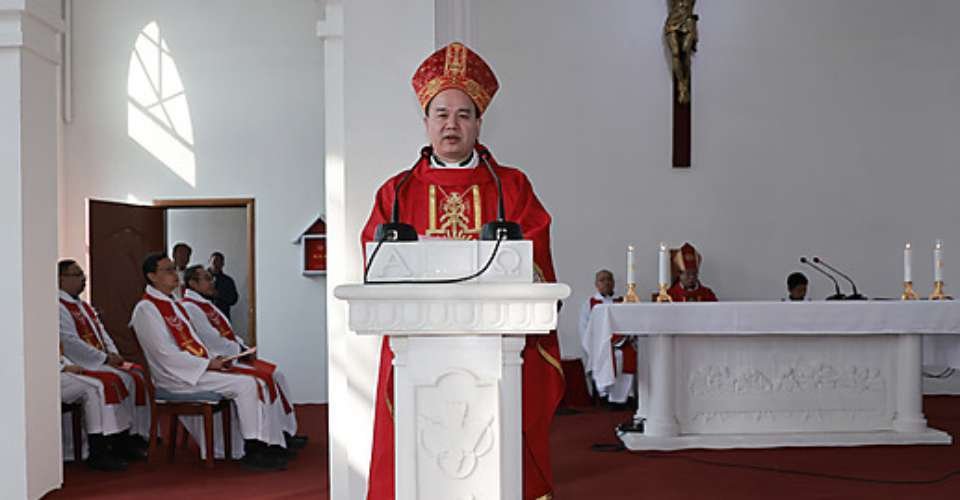
The Vatican replaced detained underground Bishop Joseph Zhang Weizhu in the Apostolic Prefecture of Xinxiang with Bishop Francis Li Jianlin in a December 5 ceremony, drawing praise from the Chinese Communist Party (CCP) but serious concern from China’s underground Catholic community.
Zhang, secretly ordained in 1991 with Vatican approval but never recognized by Beijing, has been detained since May 2021 and his whereabouts remain unknown. He was arrested just after recovering from cancer surgery, along with priests and seminarians, for allegedly violating regulations requiring clergy to register with the state. Chinese authorities barred him from attending his successor’s ordination.
China officially recognizes only five religions: Buddhism, Catholicism, Islam, Protestantism, and Taoism. These groups operate under state-sanctioned patriotic religious associations supervised by the United Front Work Department (UFWD), the CCP’s propaganda and influence arm. In 2018, the State Administration for Religious Affairs was absorbed into the UFWD, bringing all religious affairs under direct Party control.
The constitution protects only “normal religious activities,” without defining what “normal” means, and forbids religion from disrupting public order, impairing citizens’ health, or interfering with education. Clergy must support CCP leadership and adhere to the Sinicization of religion. Religious activity is restricted to approved premises, and the state maintains control over clergy appointments, publications, finances, and seminary enrollment. Minors are forbidden from entering places of worship, and pastors and imams have been instructed to emphasize socialist values in their teachings.
Under the Sinicization campaign, the Three-Self Patriotic Movement and the Chinese Christian Council drafted a five-year plan to retranslate the Old Testament and provide new commentary on the New Testament to align scripture with socialist ideology. A 2020 university textbook even rewrote the Gospel account of the woman caught in adultery, replacing Jesus’ mercy with a fabricated story in which he stones the woman and declares, “I am also a sinner.”
Across Henan province, officials forced Protestant churches to replace the Ten Commandments with Xi Jinping quotes. Authorities have ordered the removal of crosses and replaced images of Christ and the Virgin Mary with portraits of Xi. These campaigns censor religious texts, compel clergy to preach CCP ideology, and mandate the display of political slogans.
The Chinese Catholic Patriotic Association, one of the five official religious bodies, operates under CCP control and violates Catholic doctrine by asserting authority over bishop appointments. The Vatican has tried to narrow this divide through the 2018 Sino-Vatican provisional agreement, but the Patriotic Association remains structurally separate from Rome.
Alongside the official church, tens of millions of Chinese attend underground Catholic and Protestant churches, which reject state interference and refuse to alter doctrine to suit socialist ideology. These communities face constant surveillance. Authorities use grid management systems, assign local officials to monitor religious activity, and infiltrate churches with informants. When underground groups are discovered, raids often follow and participants are arrested.
The Vatican accepted Zhang’s resignation six years before the canonical retirement age. Shortly afterward, Chinese authorities formally recognized him as a bishop. The Holy See called the “civil recognition” an important step in dialogue with Beijing. His successor, Bishop Li Jianlin, has a history of alignment with Party directives, including cosigning a 2018 order enforcing a ban on minors attending Mass in Henan.
Cardinal Joseph Zen has repeatedly denounced the 2018 agreement as a “sellout” and “betrayal” of underground Catholics who endured decades of persecution for their loyalty to the pope. Critics argue the agreement emboldened authorities to intensify repression while the Vatican remains muted in its public criticism of China’s rights violations.
Zhang’s resignation, issued while he was detained and unable to communicate freely, raises serious doubts about whether it was voluntary. Underground Catholics, often called Vatican loyalists, have remained faithful to Rome since the 1950s, when the Patriotic Association began appointing bishops without papal approval. This created two Catholic communities in China: the state-controlled Patriotic Church and the underground Church that preserved communion with the pope.
After 1978, the Vatican temporarily allowed the underground Church to ordain bishops without a papal mandate, a concession Pope Benedict XVI rescinded in 2007. Benedict reaffirmed that China has one Catholic Church and no formal schism, while clarifying that sacraments administered outside communion with Rome were valid but illicit.
The 2018 agreement was intended to unify episcopal appointments, yet it has constrained Vatican support for the underground Church even as priests, nuns, and lay Catholics continue to be imprisoned, tortured, and in some cases killed for refusing to join the state-sanctioned church.
Government pressure has forced many underground clergy to join the Patriotic Association by requiring political indoctrination and public acts of submission, such as concelebrating Mass with government-approved bishops. Underground Catholics are left torn between conscience, loyalty to the pope, and a Vatican that prioritizes diplomatic engagement with Beijing over their protection. Those who refuse face arrest, surveillance, and continued detention.
Since the agreement, persecution has escalated. At least seven Catholic bishops have been detained without due process, and police have placed clergy under house arrest, imposed fines on the faithful, expelled parish priests, and arrested seminarians. Rather than stabilizing Church affairs, the agreement has coincided with an expanded crackdown aimed at weakening the underground Church that has endured the harshest repression.
The post Vatican Accepts Resignation of Jailed Bishop, Raising Questions About Religious Freedom in China appeared first on The Gateway Pundit.
Source: The Gateway Pundit
TruthPuke LLC hereby clarifies that the editors, in numerous instances, are not accountable for the origination of news posts. Furthermore, the expression of opinions within exclusives authored by TruthPuke Editors does not automatically reflect the viewpoints or convictions held by TruthPuke Management.